



Best Chess Analysis Site in 2026: Free Review, Website, or Software?
Lost a game you thought was won? Annoying. Now you want to know what actually went wrong. The best chess analysis site for that job is not automatically the one with the highest engine depth or the biggest brand. It is the site that matches the job: raw engine truth, a polished game-review report, or a plain-language explanation you can remember in your next game.
If you want a free chess analysis website that gives pure numbers, use Lichess. If you want the familiar Game Review scorecard, Chess.com is still the default place many players start. If you want desktop chess analysis software for databases and opening prep, ChessBase or SCID solve a different job; the broader best chess software comparison covers that lane. If you want a review that explains why a move was bad in plain English, that bucket is much thinner. Chessvia is our product, and it belongs in that last bucket; we are saying that plainly up top instead of pretending this is a neutral encyclopedia page.
Quick answer: Lichess is the best free raw-engine site. Chess.com is the familiar Game Review workflow. ChessBase and SCID are the serious desktop-software lane. Chessvia is the plain-English review option when you want the reason behind the engine line, not just the number. That is why this page now answers "best chess analysis site," "best chess analysis website," "best free chess analysis," and "best chess analysis software" without pretending one tool wins every job.
If you are choosing right now: start with your own last PGN. Use Lichess when you only need the Stockfish line. Use Chess.com when you want the familiar report-card flow. Use Chessvia when the real question is "why was that move bad?" and you want the answer written out before you pay for anything.
What is the best chess analysis site?
There isn't one winner, and any page that tells you there is hasn't thought about it. Google's own AI Overview for this search sorts them the same way, into completely free tools, guided learning, and advanced AI explanations. Three different jobs, really. Pick by the job.
Want raw engine truth for free? Lichess. Want a graded move-by-move report? Chess.com's Game Review or Chessify. Want the analysis to explain, in words, why the move lost, without paying to find out? That last bucket is thin, and it's the one this page cares about most.
The honest map:
| Search job | Best starting point | What you get | Where Chessvia fits |
|---|---|---|---|
| best chess analysis site | Lichess for raw engine; Chessvia for explained review | A web page you can use right after a game | Chessvia wins when the review has to explain why |
| best chess analysis website | Lichess, Chess.com, Chessigma, DecodeChess, Chessvia | Browser-based analysis without installing desktop software | Chessvia is the coach-style website, not the biggest network |
| best free chess analysis | Lichess for unlimited Stockfish; Chess.com for one free Game Review/day | Free engine lines or a limited report-card workflow | Chessvia adds plain-language reasons to the free review job |
| best chess analysis software | ChessBase or SCID when you need databases | Serious desktop study and opening preparation | Chessvia is lighter: one game, one lesson, no database setup |
- Free raw engine: Lichess, plus small no-login boards like Chesskit and ChessCompass. Great numbers, zero words.
- Graded reports: Chess.com Game Review and Chessify. Nice labels and accuracy scores, but the deepest review features usually sit behind a paid plan. If that is the exact comparison you are making, the free Chess.com game review guide breaks down the free daily limit, PGN route, and when a plain-English AI review is the better next step.
- Desktop software: ChessBase or SCID when you want a local database, opening prep, and long study sessions.
- Explains the why: DecodeChess, Chessigma's Supercoach, and Chessvia's free review. This is where "best" gets interesting, because most of it costs money.
Chessvia's /analyze lands in that third bucket as the free entry. You import a finished game, and instead of only handing you a number, the review grades each move, shows the engine's better line, and writes out the reasoning in plain English. Free, while the tools that also explain the why mostly charge for it. More on exactly how that reads in a minute.
The free-limits reality: what each site actually gives you
This is the part every roundup skips. "Free" rarely means what you'd guess it means. So below is the actual ceiling on each one, as it stood when we last checked in mid-2026. These numbers drift, though. Treat the table as a starting point, and glance at the source before you lean on it.
| Site | Free game reviews | Engine | Explains the "why" in words? | Login to analyze? | Cost for full depth |
|---|---|---|---|---|---|
| Chessvia /analyze | Free finished-game review (graded moves + the engine best line) | Checked against a real Stockfish engine | Yes, plain-language, free | No login to start | Paid coaching tiers after the free trial |
| Lichess | Free analysis board; deep server analysis is listed at 40 games/day | Stockfish 16+/18, with unlimited local analysis-board use | No, mostly numbers, lines, and mistake replay | No | $0 |
| Chess.com Game Review | Limited free review | Strong, cloud engine | Partly, short labels | Yes | Premium for unlimited Game Review (price varies by plan/region) |
| DecodeChess | Free plan lists 1 Decode Game/day | Stockfish + explanation layer | Yes, structured text | Yes | $8.25/mo or $84/yr for Unlimited |
| Chessigma | Free analyzer/report tier | Stockfish, no-login analysis | Only in the paid coaching layer | No, for the analyzer | Paid tiers; yearly listed at $97 when re-checked |
| Chesskit / ChessCompass | Unlimited, free | Latest Stockfish | No | No | $0 |
Read down the "explains the why" column and the pattern jumps out. Free and wordless is easy to find. Free and explained, in plain language, is rare. That's the whole gap. Chessvia sits in it on purpose. Chessigma's analyzer is strong, to be fair, but the coaching/explanation layer is a paid tier; DecodeChess explains moves well, but its Unlimited plan is now listed at $8.25/mo or $84/yr.
Chess analysis with explanation: the same game, two reviews
Talking about "plain-language explanations" is cheap. Let me show you instead, on a position every improver has been on the wrong side of.
Black's last move, Nf6, looks fine. It develops a piece and hits the white queen on h5. So why is it losing? Two tools tell you two very different things.
A raw-engine site (Lichess, or any Stockfish board) shows you this: evaluation swings hard toward White, best move for Black was g6, and White now has mate in 1. All true. All useful, if you already know how to read it. But it never says the actual lesson. If your comparison starts from Chess.com's broader ecosystem rather than the analysis job, the Chess.com alternatives guide breaks that decision out separately.
A plain-language review says the thing you needed to hear: your knight went hunting the queen and left f7 hanging. The queen on h5 and the bishop on c4 are both aimed at f7, and f7 is defended only by your king. You had one job that move, cover f7 with g6 or Qe7, and Nf6 did the opposite. Now Qxf7 is mate, because the king can't take a defended queen and has nowhere to run.
Same board. One review hands you a number, the other hands you the idea you'll actually remember next game. If you've ever stared at a "??" symbol wondering what it wanted from you, read our full breakdown of why a move gets flagged as a blunder. That gap, number versus reason, is the entire case for the "explains why" bucket.
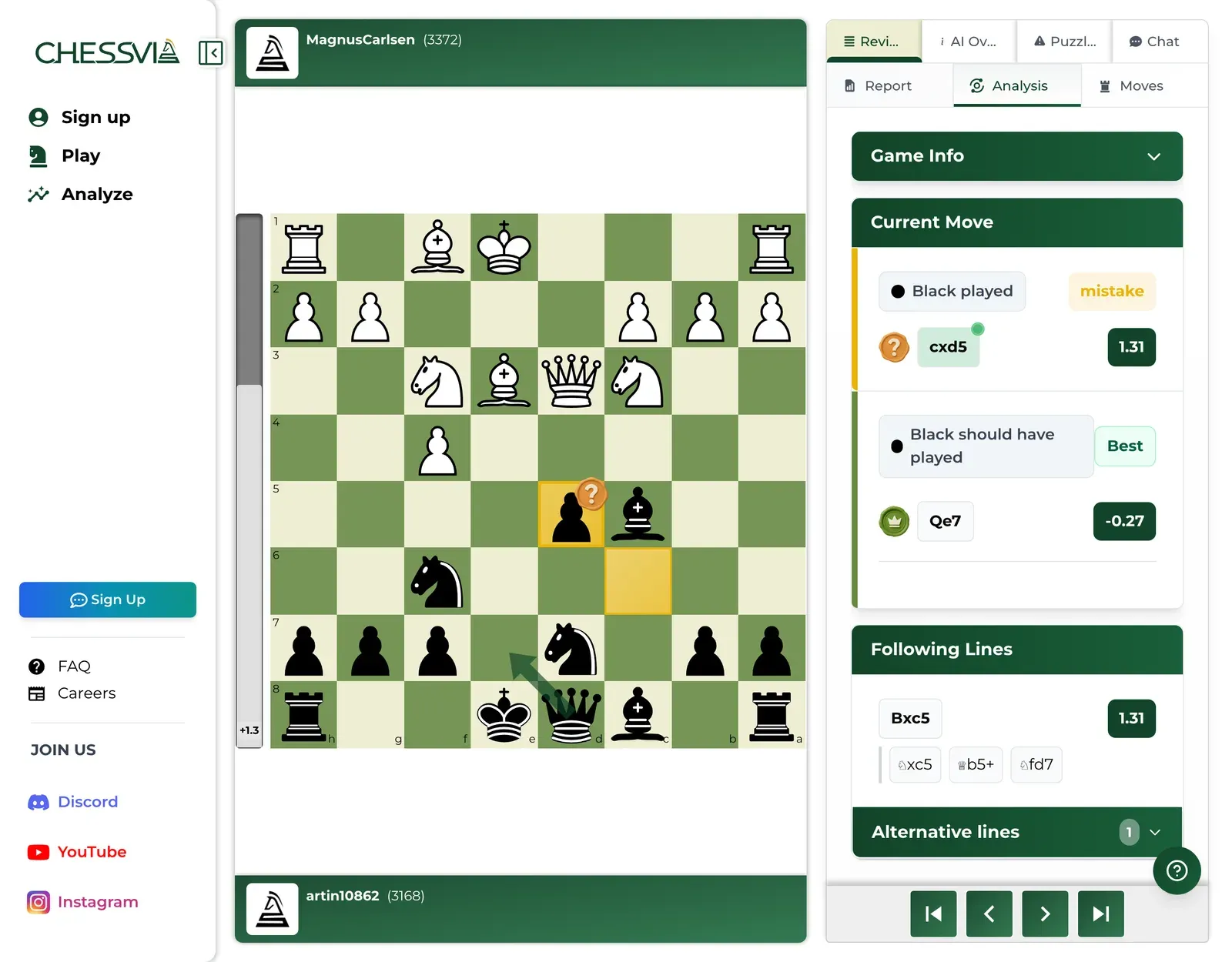
One honest limit worth stating: the free /analyze review explains the why to you, but it's a one-way read for now. The in-review "Chat with Chessy" (asking follow-ups on your reviewed game) is coming soon, not shipped. If you want a coach you can actually talk back to, that lives on /play, where you play a practice game against Chessy and it comments as you go. We'd rather tell you that than let you find out later.
Best free chess analysis: the honest raw-engine picks
If your only need is "what does the engine think here," you never have to pay anyone. These are the free picks worth bookmarking, and yes, I'm sending you to sites that aren't us, because for raw numbers they're the right call.
Lichess first, always. It's free, it's open, and its analysis board runs Stockfish with no login and no nag screens. The current features page lists the analysis board, mistake replay, studies, and local engine analysis as free; its deeper server-side game analysis is listed separately at 40 games per day. If a number is all you want, stop here.
Small and login-free. Chesskit and ChessCompass do one thing, run the latest Stockfish on your game, and skip the account entirely. Thin on words, fast on numbers. Handy when you just want a quick second opinion.
Chessigma deserves a real mention. Its free analyzer gives Stockfish reports with no login, which is why it ranks so well, and the tool itself is legitimately strong. The catch is the explanation layer: Chessigma's coaching sits in the paid product, and the pricing page now lists Free plus Monthly, Yearly, and Lifetime options, with Yearly at $97 when re-checked. So "free" gets you the analyzer and report, not the same plain-language coaching comparison. If that is the product you are weighing, our current Chessigma review and Chessvia comparison covers its free analysis, Froggy/Supercoach, pricing, and the honest tradeoff.
Want the community's read? Scroll the r/chess "best analysis tool" thread and one answer keeps surfacing: "Lichess for the engine, something else for understanding it." That's this whole page in a sentence. Even the big roundups miss it. Chessify's top-websites list ranks the engine tools just fine, then skips the explanation category like it isn't a thing.
Best chess analysis software: when desktop tools make sense
"Software" is a different question than "site." Usually it points at one of two crowds. First, the serious study-at-home player who wants ChessBase or the free SCID, bolts a strong engine like Stockfish into it, and keeps a database of every game they've ever played. Powerful stuff. Also total overkill for the rest of us. If your query is literally "best chess analysis software," start there instead of forcing a web tool into a database job.
A club or intermediate player who just wants to know what went wrong after a blitz game? Desktop software is more machinery than you need. A web review does the job in about a minute, from your phone, right after the game while it still stings. Pick the heavy software only if you're annotating openings for the long haul. Otherwise a site wins on friction alone.
Which chess analysis site should you pick?
Let me make this quick, by reader.
You want free engine numbers and nothing else. Use Lichess. Done, save your money.
You want a clean graded report with accuracy scores. Chess.com's Game Review or Chessify, knowing the deepest analysis wants a subscription. If your search is really "best chess review free" after a Chess.com game, use the free Chess.com game review walkthrough for the exact free-limit and PGN path, then come back here for the broader market map.
You want the analysis to explain the why, in words, without paying to find out. That's the narrow bucket, and it's where Chessvia's free review sits: a free account, no payment, and you read the reasoning, not just the score. Not sure the AI reasoning holds up? Fair, we wrote a whole honest piece on whether an AI chess coach actually works, and if DecodeChess is the one you're weighing, here's our head-to-head with DecodeChess.
The fastest way to judge any of this is to stop reading comparisons and run one of your own games. If you want the repeatable review habit before choosing a tool, use our 5-step chess game analysis system first: replay engine-off, find the eval swing, dig out the why, name the pattern, then log one lesson. Then paste a finished game in, free, and see if the plain-language why lands for you. Takes about a minute, start to finish, and you'll know immediately whether reading the reason actually beats reading the raw number.
Review One of Your Games Free: See the Why, Not Just the NumberPrefer to play a game first and get coached as you go? That's the live side.
Play a Practice Game Against a Coach That Explains Every MoveFrequently Asked Questions
What is the best free chess analysis site or website?
For raw engine evaluations and lines, Lichess is free, login-free, and hard to beat. For a free review that also explains the why in plain words instead of only numbers, Chessvia's /analyze review is the comparison point. Pick based on whether you want the number, the report card, or the reason behind it.
What is the best chess analysis software?
Depends how deep you go. For serious home study and databases, the classic desktop picks are ChessBase (paid) or the free SCID with a strong engine like Stockfish bolted on. Most club and intermediate players don't need any of that, though. Just want fast, clear feedback right after a game? A web site does the same job from your phone in about a minute.
Is there a chess analysis site that explains moves in plain English?
Yes, a few. DecodeChess writes structured explanations, Chessigma's Supercoach does it for about $14/mo, and Chessvia's free review explains the reasoning in plain language, with its analysis checked against a real engine. Lichess and most raw-engine boards give you the numbers but not the words.
Do these chess analysis sites work on mobile?
The web ones do. Lichess, Chess.com, Chessigma, and Chessvia all run in a phone browser, so you can review a game the moment you finish it. Desktop software like ChessBase is the exception, that's a computer-only setup.
Can a chess analysis site help me during a live game?
No, and it shouldn't. Every site here is for reviewing a finished game, not for getting help mid-game against a real opponent, which is cheating on every major platform. Playing a practice game against a coach, like Chessvia's /play, is a separate thing, that's you versus the coach with no human on the other side. The point is to get better on your own, not to lean on a tool during a rated game.
How current are these free-limit and pricing details?
We re-checked the major source claims for this refresh on September 1, 2026 where the live pages were reachable. Lichess still describes itself as free/libre, open-source, 100% free, and powered by the latest Stockfish analysis. Chess.com says a free account includes one full Game Review per day. Chessigma now leads with a free 25-game report and describes a 1,000-game, 250-number paid report. DecodeChess pricing was not reachable during this tick, so treat the older price note as dated and check its vendor page before buying.
You just wanted to know why you lost. The best chess analysis site for that isn't the one with the flashiest score, it's the one that answers the question in words you'll remember. Run one of your own games and see which bucket you actually live in.
Paste Your Last Game and Read the Plain-Language Why