



DecodeChess Review: Free Tier, Pricing, and Best Alternative
Looking for a straight DecodeChess review before you pay? Short answer: DecodeChess is worth it if you want a polished written report and only need a limited free check before subscribing. As of August 29, 2026, DecodeChess lists a Free plan with 1 decoded game per day, plus an $8.25/month Unlimited plan and an $84/year Unlimited plan. If you want the best DecodeChess alternative that starts free and lets you talk through the position after the report, Chessvia is the closer fit.
That is the whole decision in plain English. DecodeChess writes, you read, and its paid version is strong at that. Chessvia reviews the game and then lets you ask "why not this move?" on a coach surface tied to your games. This page puts both tools' real output side by side, breaks down what each one actually does feature by feature, and covers pricing, free-tier limits, migration, and the honest gaps on both sides, not just ours. Yes, Chessvia is our product, which is exactly why we're showing you real screenshots instead of asking you to take our word.
DecodeChess has a limited free plan. Chessvia is a free-starting AI chess coach plus game review. Pick DecodeChess for 1 free decoded game per day or a fixed Threats / Plans / Concepts write-up once you pay; pick Chessvia if the next question after the report is usually "but why?"
| DecodeChess | Chessvia | |
|---|---|---|
| Price | Free plan: 1 decoded game/day · Unlimited $8.25/mo or $84/yr | Free tier · Silver $7/mo (~$5 annual), no card |
| What you get | A written report | A conversation on the board |
| When it helps | After the game | After the game + live while you play |
| Explains WHY | Yes on paid Unlimited / credits | Yes |
| Grounded in a real engine | Yes (Stockfish) | Yes (every answer engine-checked) |
| Ask a follow-up | No (read-only) | Yes, live on the same position |
| Plays + coaches you | Yes, computer opponent included | Yes, at /play |
| Voice / remembers your games | No | Early access |
| Best for | A polished report with a limited free check | Asking questions + improving free |
The one difference that decides it: DecodeChess writes, you read. Chessvia answers back. Everything below is downstream of that.
How DecodeChess's Threats, Plans, and Concepts framework actually works
Credit where it's due first (yes, we're a competitor saying this). DecodeChess is a genuinely well-designed system. Every position gets sorted into three buckets. What's Threats? What your opponent's pieces are aiming at right now, the tactic you'd miss if you weren't looking. Plans covers the strategic ideas sitting in the position: where to expand, which pawn break makes sense, which piece wants to improve. And Concepts, that's the underlying principle the position is teaching you. An outpost. A weak color complex. A bad bishop. Under the hood it's a real engine, same as everyone else's. What DecodeChess does differently is translate that output into the three-part breakdown above, in plain English, on every position, same format every time. Consistent, if nothing else.
That consistency is the actual product. You always know where to look. A beginner working through a loss doesn't have to guess what "the move was bad" means, it's filed under Threats, Plans, or Concepts, every time. That predictability is genuinely valuable, and it's the reason DecodeChess still has switchers who miss it after they leave.
What Chessvia's analysis actually looks like
Take a real game, run through Chessvia's free /analyze. Black plays Nbd7. Flagged: inaccuracy. Eval moves to 0.6 for White. And right there next to it, the better move: Be7 (Best, −0.08), plus what follows it (Be3, or the sharper ...e7 line). Not just a colored mark. The actual move, and a number proving exactly how much it cost. We built the same grading logic into a whole breakdown of why moves get flagged as blunders, worth a read if this is the part you keep getting wrong.
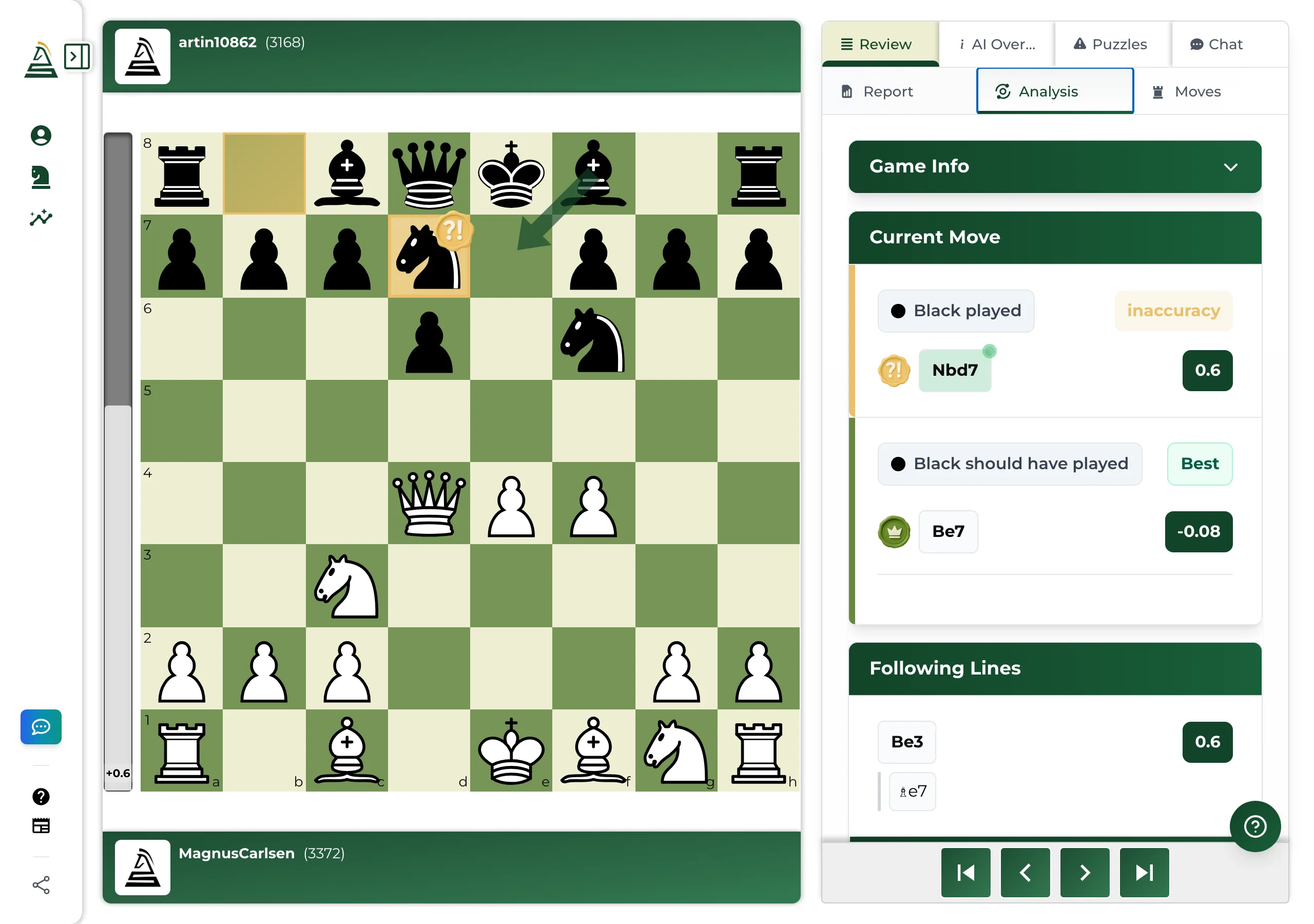
That's the same core job DecodeChess does, grade the move, show what should have happened instead. /analyze itself has a Review section with three sub-views, Report (accuracy score and move classifications), Analysis (the move-by-move breakdown shown above, with engine lines you can step through), and Moves (the full move list), plus a separate AI Overview tab: a written summary of the game's turning points and a personalized study plan based on the mistakes you actually made, closer to DecodeChess's Concepts bucket than a raw move grade. Where Chessvia adds a layer neither DecodeChess nor a plain engine has is Chessy, the coach you can actually talk to about any of it.
The part DecodeChess can't do: talk back
DecodeChess writes a report and stops. Chessvia's coach, Chessy, sits alongside your games. Ask it a question in your own words and it answers grounded in the position, not a canned template.
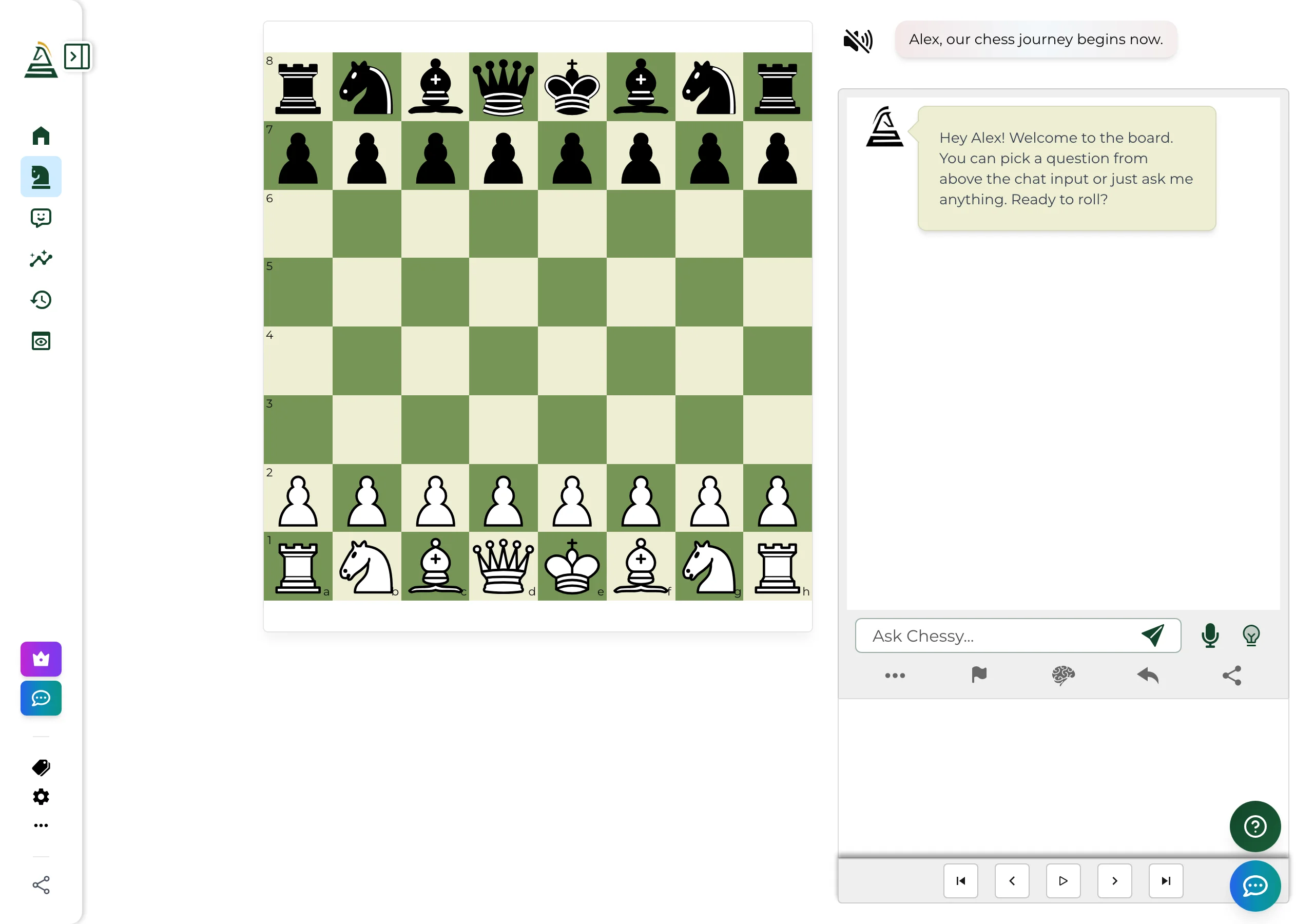
At /play you play a real practice game against Chessy and ask it anything mid-game (for example, "what's the best move here and why?") in the chat panel next to the board. There's also a dedicated Chessy Chat for general chess questions, connected to your account: ask about openings, get quizzed on chess principles, or get a personalized read on your strengths and weaknesses pulled from your actual game history. What's not there yet: an inline "ask a follow-up" button built into a specific graded move inside the /analyze report itself, that's still on the roadmap. The conversation exists today, just as its own surface, not stitched into every review line.
Pricing and free tier, tier by tier
DecodeChess now has a real but narrow free tier: 1 decoded game per day, play-vs-computer access, and no Deep Decode / deep explanations. The paid subscription is $8.25/month for Unlimited, or $84/year if you pay annually. It also sells one-time credit packs: $15 for 60 credits and $25 for 120 credits, valid for 12 months. Chessvia's pricing is tiered, so the actual comparison depends on how deep you go:
- Free: unlimited /analyze reviews (grading, best-move lines, accuracy report), a practice game against Chessy at /play, and access to Chessy Chat with usage limits.
- Silver, $7/mo (~$5/mo annual): the direct price match to DecodeChess: higher usage limits across analysis and chat, priority processing.
- Gold, $14/mo (~$10/mo annual): deeper AI Overview study plans and expanded coaching limits.
- Platinum, $19/mo (~$12.40/mo annual, $149/yr): the full tier: custom Chessy personalities, the highest usage ceilings, and first access to features still in early access (voice, per-game memory).
So the honest price comparison is Chessvia Free/Silver versus DecodeChess Free/Unlimited. DecodeChess Free is useful for one daily report. DecodeChess Unlimited is now cheaper than Chessvia Gold or Platinum, and still strong if the fixed report is all you want. Chessvia's edge is not pretending DecodeChess is pay-only; it is that Chessvia's free start is built around the review-plus-coach loop, then Silver matches the same $7/mo class for players who want higher usage limits.
Which one is right for you
If neither pitch fully lands, widen the search before choosing. Our best chess websites guide compares the broader field by job—play, free analysis, written reports, and coaching. If post-game analysis is the job you care about, the best chess analysis sites comparison separates free engines, graded reviews, explained analysis, and desktop software. The best AI chess coaches comparison goes deeper on coaching tools. Otherwise:
- Pick DecodeChess if you want a polished, structured written report at the lowest price and you're happy reading an analysis rather than questioning it. Its Threats/Plans/Concepts layout, the same tidy structure on every position, is genuinely good and years-refined.
- Pick Chessvia if you want a coach you can actually talk to, ask questions in Chessy Chat or while playing a practice game at /play, plus a free graded review of your games, and you'd rather start free and decide later.
By rating, honestly
- Under 1000: You need volume and plain-language explanation more than you need a fixed framework. Chessvia's free review covers that repeatedly without a subscription. DecodeChess's free plan gives you one decoded game per day, and its paid Concepts bucket is useful too, but you're paying once that daily limit is not enough.
- 1000-1800: This is where DecodeChess's structure earns its price, Threats/Plans/Concepts becomes a genuinely useful lens once you know enough to use it. It's also exactly where Chessvia's follow-up questions matter most, because generic explanations stop being enough and you start needing to ask "but what about this instead?"
- 1800+: Both tools' auto-generated explanations get less useful at this level, you're closer to needing a titled human coach for prep and psychology. Either tool is a fine daily-review layer underneath that, not a replacement for it.
Where DecodeChess still wins
We're not going to pretend otherwise: DecodeChess's fixed, structured format is a real strength. The same Threats / Plans / Concepts layout on every position is predictable in a way a conversation isn't, and some players genuinely prefer that. If a clean written breakdown is the entire job you want done, no follow-ups, no play, no memory, DecodeChess does that one job well, and at a low, single-tier price with no decision to make about which plan.
Where Chessvia is honest about its gaps
A recommendation you can't trust is worthless. What Chessvia doesn't do yet:
- The free /analyze review itself is a one-way read, there's no "ask a follow-up" button built into a specific graded move yet. The conversation lives at /play and Chessy Chat, not inline in the report.
- Voice coaching and per-game memory are early access, not finished.
- Live coaching during a rated blitz game isn't solved, latency makes that genuinely hard, and using it live would be cheating anyway.
What it does do well, right now: grade every move, show the better line, explain it in plain English, and let you talk to a coach, either about your reviewed games in Chessy Chat, or live while playing a practice game at /play.
Switching from DecodeChess: how your habits map over
If you're moving over, here's how the workflow changes. Your DecodeChess habit is: paste or load a position, read the Threats/Plans/Concepts breakdown for that single moment, close it. Chessvia's loop starts the same way, import a finished game at /analyze, and it grades every move automatically rather than requiring you to paste positions one at a time, but then it bends. You read the why behind the moves that actually mattered, and then you ask the follow-up the static report couldn't answer. That last step is new, and it's the reason to switch.
What you'll give up: DecodeChess's identical three-part structure on every position is predictable in a way Chessvia's conversational answers aren't. Some players genuinely prefer that consistency, especially early on. If that's you, lean on Chessvia's Report and AI Overview tabs first, they're closer to a fixed structure, and treat the chat as a bonus rather than the main event until it feels natural.
What about a free chess analysis tool?
Want just the raw engine number? Lichess is free and excellent for that, evals and best lines all day. No explanation, though. And that eval was never what DecodeChess users were actually paying for. Lichess won't say why a move failed. Neither will raw Stockfish. Ask either one and you get a number, not a reason. That plain-language why is DecodeChess's whole niche. Chessvia's free review does it too, just as a conversation instead of a fixed template. Don't take our word for either one. Grab a game you actually lost and run it through /analyze, then put it next to what DecodeChess gives you.
Review One of Your Games FreeFrequently Asked Questions
What is the best DecodeChess alternative?
For the plain-language "why" plus a coach you can actually talk to (at /play or in Chessy Chat), Chessvia is the closest fit, and it's free to start (yes, ours; that's why the real screenshots are on this page). DecodeChess now also has a limited free tier: 1 decoded game per day. If you only need raw engine evals for free, Lichess covers that too, minus the explanations.
Is DecodeChess worth it in 2026?
Worth it if you want the deepest pure-text breakdown of a position at a low price and you do not need to ask follow-ups. The free plan is a useful limited test. Unlimited is $8.25/month or $84/year, and it remains very good at that one report-style job. It is the wrong pick if you want a two-way conversation you can question, or live coaching while you play.
Does Chessvia explain moves like DecodeChess?
Yes, and then it keeps going. Both explain why a move was good or bad in plain language, grounded in a real engine. The difference: DecodeChess hands you a fixed written report and stops there, while Chessvia also gives you a coach you can talk to about your games, at /play or in Chessy Chat. Voice and per-game memory are early access.
Is Chessvia free, or do I need to pay like DecodeChess?
Chessvia's free tier covers unlimited /analyze reviews and a practice game against Chessy at /play, no card required. DecodeChess's free plan covers 1 decoded game per day, while Deep Decode and Unlimited use require the $8.25 monthly plan, the $84 yearly plan, or a one-time credit pack. Chessvia's Silver tier ($7/mo, ~$5/mo annual) is the direct price-class match if you want higher usage limits.
Can I import a PGN or a Chess.com/Lichess game into Chessvia?
Yes, /analyze takes a pasted PGN, a Chess.com username (it pulls your recent games), or a Lichess username, the same three import paths DecodeChess supports.
What is the best free chess analysis tool?
For raw engine evaluations and lines, Lichess is free and hard to beat. For a free review that explains the why in words instead of just numbers, that's what Chessvia's game review does. Pick based on whether you need the explanation or just the eval.
Play a Game Against a Coach That Explains Every MoveFor more on how the coach reasons about moves rather than just grading them, read how Chessvia's AI coach explains the why behind every move. Free to start, no credit card required. Voice coaching is in early access.